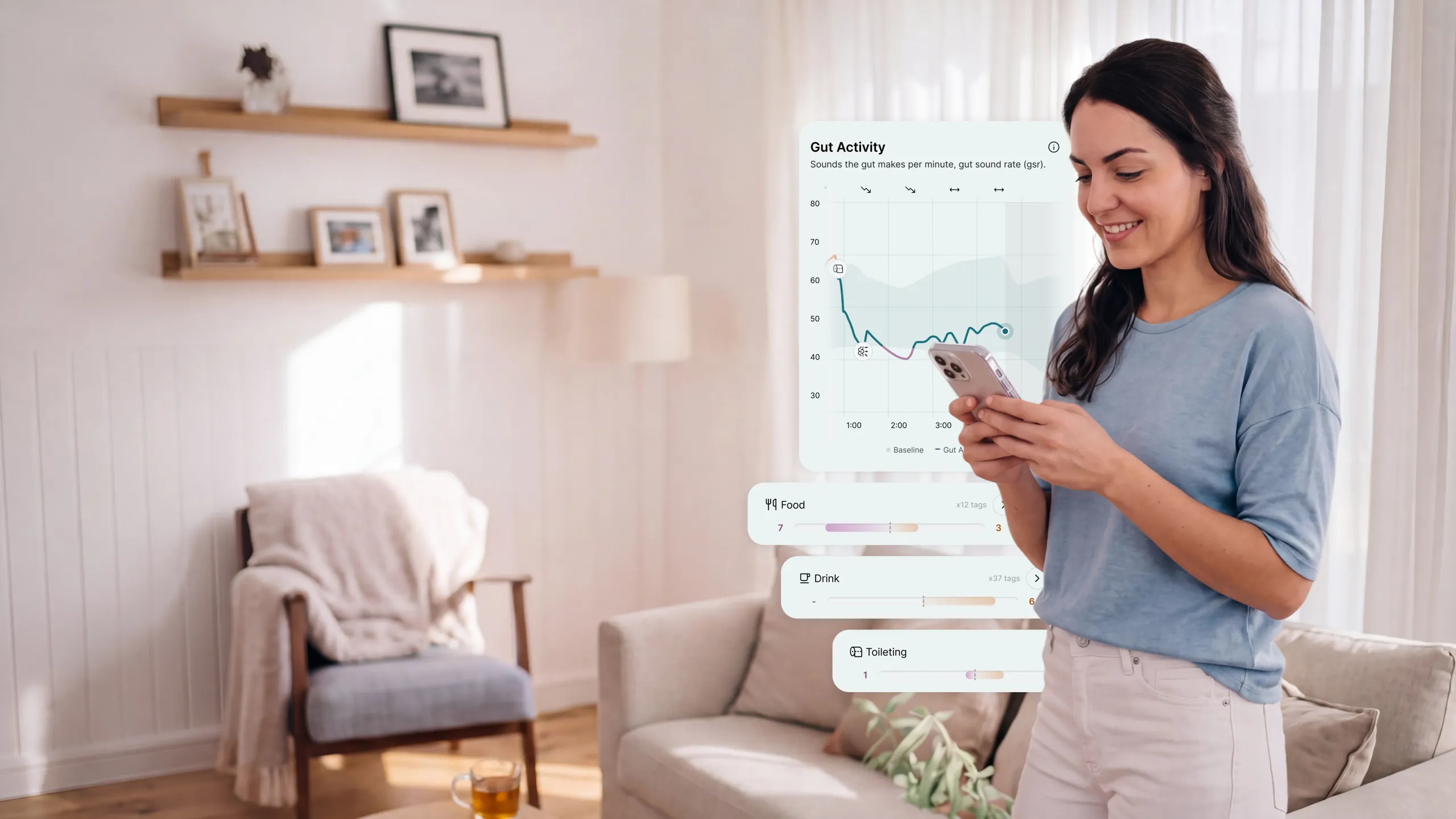
Stop guessing what your gut is doing. Start seeing it.
Your gut is constantly moving, digesting, and working, and it makes sounds when it does. We built a belt that listens to them 24/7 and acts as the first gut function monitor.
For over a century, clinicians have listened to the sounds the gut makes to understand the state of digestion, but only ever for short periods of time. Dige is designed to listen and understand, 24/7.
Now it’s on the record, you don’t have to track alone anymore.
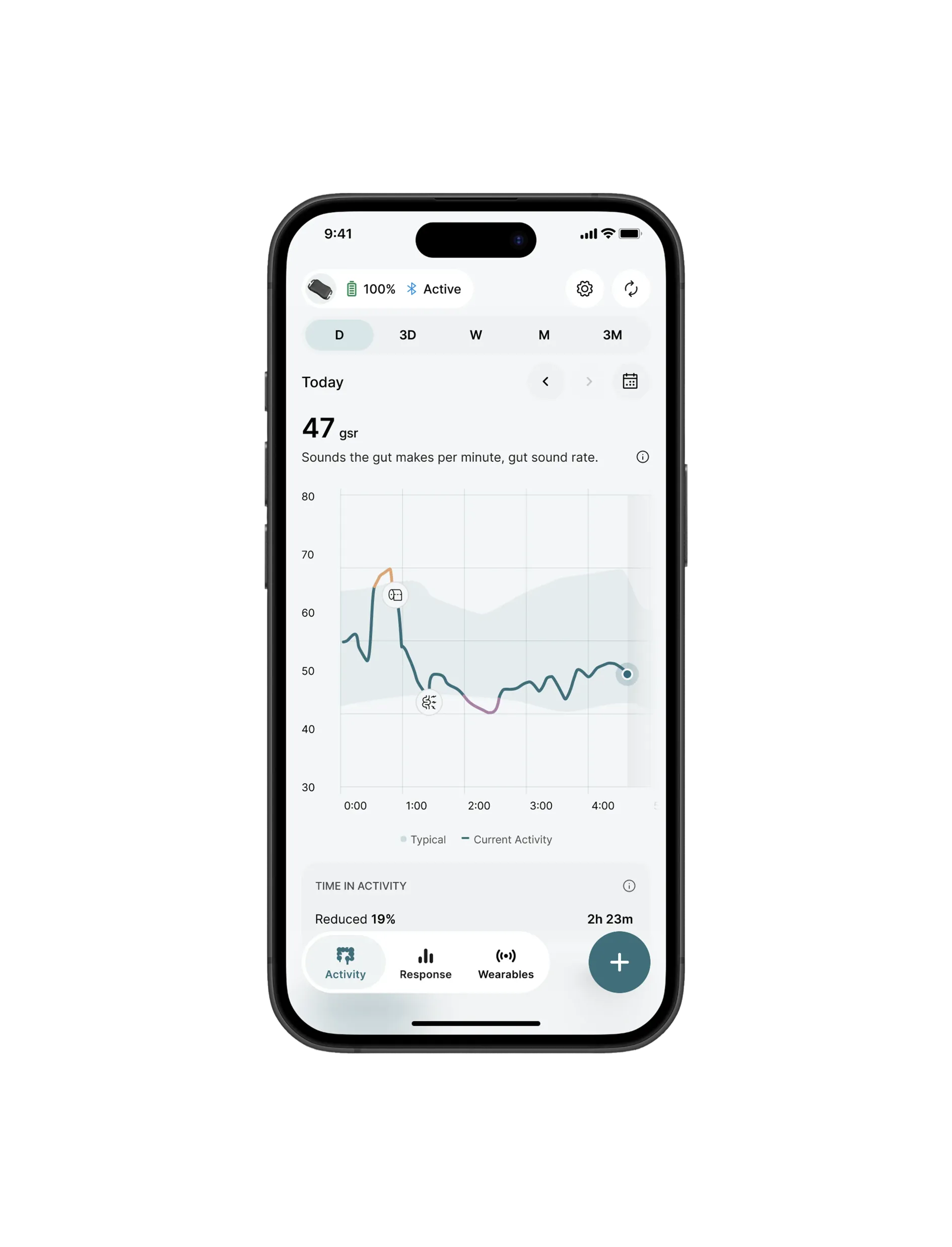
Dige measures your gut activity, which is how often your gut is audibly active, minute by minute. Each day is compared against your own baseline, not a population average.
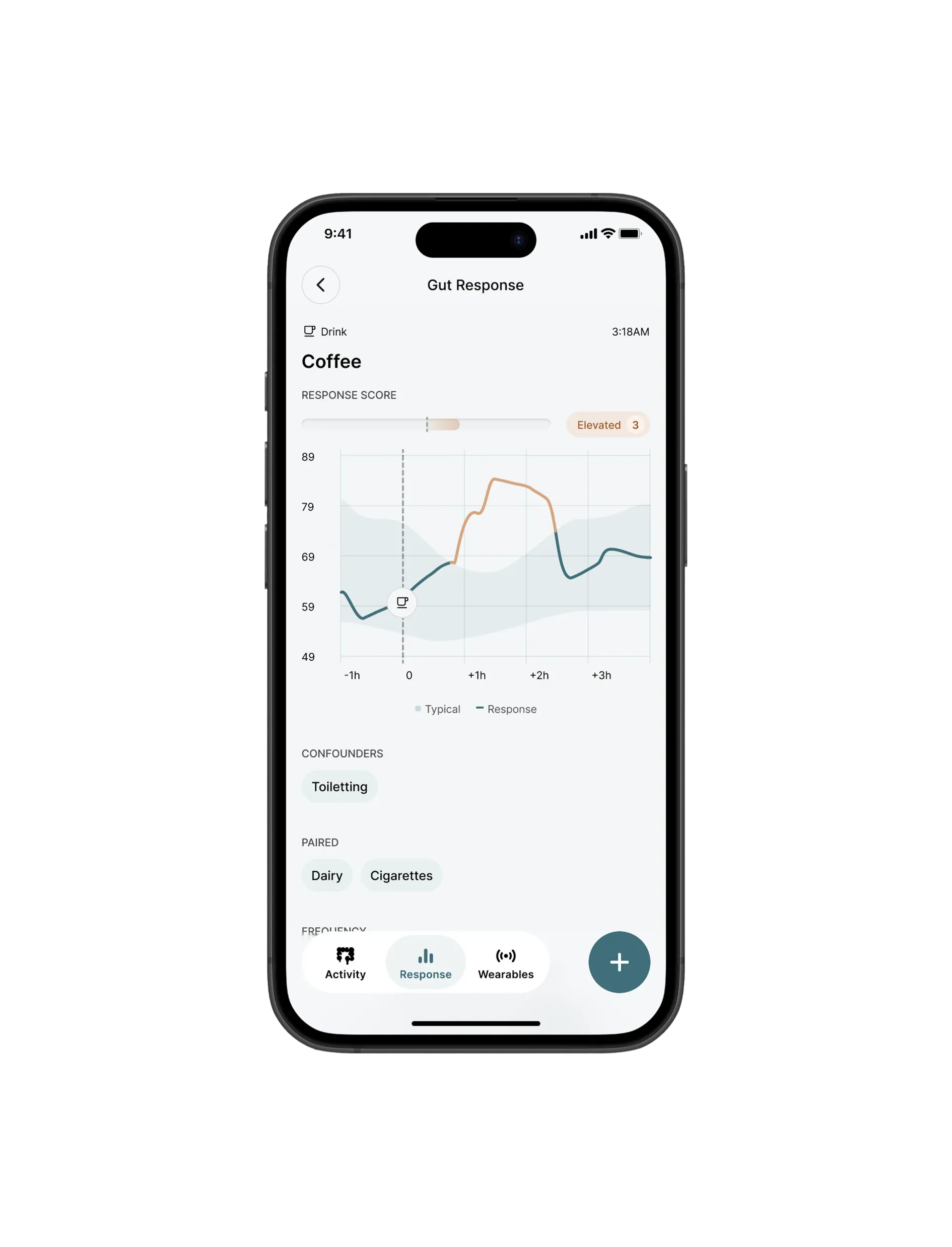
Understand how your gut responds to daily events.
Understand your gut’s response to events such as food, drink and activity. Learn how different events are paired and what influences your digestion.
What the device measures, what it doesn’t claim to do, and how to get one.
What it is and how it works:
What exactly does the DigeHealth wearable measure?
Four things, continuously: the sounds your gut makes, your heart rate, your heart rate
variability (HRV), and your movement. Together they show what your digestion is doing and
what state the rest of your body was in at the time.
See how it works
How does it “listen” to my gut — what is the sensor?
We literally listen to your gut. Our microphone sits against your abdomen and picks up bowel sounds.
Alongside them, an optical heart-rate sensor and a motion sensor complete the picture.
Hear real recordings
What does the AI actually do with the bowel sounds it records?
It runs on the wearable itself. Every sound is classified as it happens — speech,
clothing friction, movement and background noise are discarded — and what remains is
turned into a measure of how active your gut is, minute by minute. The audio is analysed
and dropped; it is never stored and never sent to us.
What kind of insights or output do I get back?
Gut activity measured against your own baseline rather than a population average; how
your gut responded to particular meals, drinks, workouts and medication; and how those
patterns move across weeks and months.
See how it works
How is this different from a smartwatch or a fitness tracker?
A smartwatch can only infer digestion from proxies such as heart rate and sleep.
DigeHealth measures the gut directly, by listening to it — a signal clinicians have used
for more than a century, but only ever in short bursts through a stethoscope.
Read the science
Wearing the device:
Where on the body do I wear it, and how is it attached?
On your abdomen, held in place by an adjustable belt around your waist. The recommended position is
the lower right of the abdomen. No fiddly adhesives to change
Is it comfortable enough to wear overnight and continuously?
It is designed to be worn and forgotten, day and night. Overnight is some of the most
valuable data we collect, because audio collection is undisturbed by background noise and movement — so the
device is built for it. Set the belt for good skin contact without it being too tight.
How big is the device?
85 × 45 × 17 mm, 65 g, 3.35 × 1.77 × 0.67 inches, 2.29 oz.
How discreet is it under clothing?
The device sits flat against your abdomen under the belt, beneath your clothes. There
is no screen or bright light that could draw attention — from the outside, there is
nothing to notice.
Can I shower, sweat or exercise with it on?
DigeHealth devices are not designed as fitness trackers (there are plenty of those).
Wear the device before and after exercise to measure your gut’s response to exercise.
Take it off before you shower, bathe or swim: it is not designed to be submerged
or held under running water.
How do I clean it?
Wipe the device with a damp cloth and a mild detergent. Don’t use alcohol-based
cleaners or wipes, and never submerge it. The belt is machine-washable on a gentle
cycle.
Who it’s for:
Is this for patients, healthy people, or researchers?
All three, through two products. Anyone curious about their digestion can wear the
device with the myDige app. Research teams use the same hardware with our Researcher app
across a study cohort. For researchers
Can it help with IBS, coeliac disease or food intolerances?
DigeHealth is a general wellness product, not a medical device —
it doesn't diagnose, treat, or monitor any medical condition.
Diet, stress, and sleep are widely recognised as playing an important role in digestive comfort.
By helping you track how your body responds to these factors day to day,
DigeHealth may support people who want to live well with conditions such as IBS, coeliac disease,
or food intolerances, as part of a healthy lifestyle.
Can it track how my gut responds to specific foods or diet changes?
Yes — it is one of the main reasons people wear it. Log a meal (photo-based logging
estimates the ingredients and their carbohydrate, fat, protein and fibre content) and see
the response that followed. Over weeks, you can compare the period before a diet change
with the period after it instead of guessing.
See how it works
Accuracy and capabilities:
How accurate is measurement of bowel sounds?
We assess the accuracy of detecting and classifying bowel sounds
based on labelling completed by a gastroenterologist. There is no
gold standard for measuring bowel sounds.
See how it works
What about background noise or movement?
We spent years developing our microphone, active noise cancelling and denoising techniques
to get the best quality bowel sound recordings possible in the real-world. We filter-out periods
where we know our recordings are too noisy, so you will only see numbers you can trust.
Hear real recordings
Can you really measure heartrate and HRV on the abdomen?
Heartrate on the abdomen is tricky, particularly during exercise due to movement artifacts.
This is why we don't try to replace your finess tracker; we integrate with a range of 3rd party wearables.
We focus on measuring what matters most to digestion: resting heartrate and overnight HRV.
See how it works
Can you measure sleep?
We don't yet have validated sleep staging implemented in our product, but we do monitor
bowel activity during sleep to give insights about overnight digestion. We pull
validated sleep scores from 3rd party wearables to enhance your experience.
See how it works
Can you estimate calories in meals?
Many factors, not just the calories in a meal, impact bowel sounds.
We can detect different responses to a small or a large meal
but our products are not validated to estimate calorie density of meals.
We wouldn't trust anyone who claims they can!
Instead we integrate with AI food logging to estimate calories based on images.
The science
Medical and regulatory status:
Is this a medical device? Is it CE-marked or regulatory-approved?
No. DigeHealth products are not medical devices, as such, and we make
no medical claims about them. They are intended for research and personal use only.
We have completed the mandatory safety
and compatbility testing required for commercial CE and FCC-marked consumber devices.
Can it diagnose or monitor my condition?
No. It measures your gut activity and reports it back to you. It does not diagnose,
treat, cure or monitor any disease, and nothing it shows you should be read as a medical
finding.
Do I need a doctor or a prescription to use it?
No. It is available directly in companies where we ship — no prescription.
Should I use this instead of medical advice from my physician?
No — and please don’t. Nothing here replaces your doctor. Keep following their advice
and keep taking prescribed medication. If something in your data concerns you, bring it
to them rather than acting on it yourself, and seek medical care for new or severe
symptoms.
Data and privacy:
Where is my data stored, and who can see it?
Raw audio never leaves the wearable — it is analysed on the device and discarded. What
syncs to your account is the result: your gut activity, your heart metrics and the events
you logged. That is stored securely in servers hosted in Switzerland and is visible to you alone. Read the privacy policy
Yes. You can ask for a copy of your personal data, ask us to correct it, or ask us to
erase it, and we respond within one month. Email
[email protected].
Do you share or sell data to third parties?
No. We do not sell personal data and never have. We share it only with the processors
that run our service, where the law requires it, or with your explicit consent — each of
which is listed in our privacy policy.
Getting one:
Is the device available to buy now, and what does it cost?
The wearable is $349 as a one-time purchase, with the Core app free forever and a month
of Premium included. It isn’t on general sale yet — early access units ship Q4 2026, and
the way in is the waitlist. See pricing
How do I get on the waitlist or join a study?
The waitlist is free and takes an email address —
. If you are a
clinician or researcher who would like to run a study with us,
get in touch instead.
Which countries do you ship to?
Early access units ship from Switzerland, and we are confirming the full list of
destinations ahead of the Q4 2026 launch. Join the waitlist and we will tell you what is
available where you are as soon as we can. Ask us about your country
Is the mobile app available yet?
The myDige app is available on the Apple Store and Google Play stores,
but you need a DigeHealth device to make it really work.
See what’s included
For researchers:
What does the Researcher app do?
It is built for study teams: enrol participants and work with processed acoustic, PPG and motion data.
Research devices can be configured to retain high-fidelity raw audio for ethics-approved
studies. For researchers
What formats does the data come in, and will it fit my existing tools?
Processed data comes in standard formats, ready for your statistical pipeline, with CSV
export coming soon.
How do I set up a research collaboration or pilot?
We co-design the protocol and endpoints with you, provide devices and the Researcher
app for your cohort, and support the analysis. Start by telling us your research question.
Get in touch
Company and trust:
Who is behind DigeHealth?
A gastroenterologist, a data scientist, a device engineer and a commercial leader,
based in Switzerland.
Meet the team
What is the clinical and scientific backing?
Peer-reviewed publications from our team, and ongoing studies with university and
hospital gastroenterology departments. Read the science
Who funds the company?
We are backed by a combination of grants and investors,
and we run funded research alongside our hospital partners.
More about us
We use only the cookies this site needs to work. We'd also like your permission for optional analytics and marketing cookies — nothing optional is set unless you agree. Read our cookie policy.